OH – MY – GOD (of Thunder!) what a trip this has been.
Sheep Milking
I have decided that when I grow up, I would like to have sheep to teach my children responsibility. I so admire the twin boys who made milking tens of animals on this rainy Saturday morning look like a walk in the park. I used to beg my mother to make me breakfast in bed when I was their age. It was heartwarming to spend our morning with such a close-knit, hardworking family. But really, any job can be fun with a sip of raki and homemade hot honey donuts!
It was very
interesting to learn about the milk, yogurt, cheese, and butter making process
afterwards. Our host explained to us that the family can never take a day of,
not even Christmas, because if the animals go without milking it will cause
them much pain. Because the cooperative does not use any preservatives in their
products, they cannot take a day off from production either, because the milk
will spoil. This family reminded me of my own. I can see how proud they are of
their farm, animals, and tasty natural products.
At home, every member of my family
plays an essential role in our family construction business. My dad, the boss,
calls us Team Santosusso. Missing my
team a little extra today, but it was incredible to feel such a connection to a
family who lives on the other side of the globe!
Psychro Cave
From our readings, we learned that in Cretan
mythology the milk of a wild goat (kri-kri) named Amalthea was used to nourish
baby Zeus. (Chnaraki 98). Because of this, the kri-kri had sacred significance
to the Minoans. So, logically, the only thing to do after our lovely lactose breakfast
was to visit the cave that is legended to have been home to baby Zeus who also
seemed to love a goat-milk snack.
I especially enjoyed
learning about Cretan mythology today. Dr. Chnaraki explained to our group that
these legends are were a form of ancient science or philosophy, used by the
ancient Greeks to explain the world around them. Because of this, there are
variations of nearly every story, which is what makes them so unique!
The Psychro
Cave is the place where Rhea took her baby, Zeus, to hide him from his father, Cronus,
to save him from being eaten. Legend has it that the people of Crete played and
danced to music loudly to cover up the cries of Zeus, keeping him safe and
sound in the cave. This is why music and dance are especially important to the
Cretan culture.
Town of Agios Nikolaos
One beautiful
town after the next! This port-town reminded me of a quaint Rethymnon. It is
unique because it is where the lake from the mountains meets the sea, creating
a very unique ecosystem that allows for cross-species to thrive. My classmates
and I enjoyed one last lunch together at a café that overlooked the water, it
was beautiful!
At the port is
a statue of Princess Europe on the bull that is Zeus set in front of calm sea
backdrop. This was my favorite statue that we have seen thus far, particularly because
of the myth it represented. The perfect ending to our Zeus-filled day.
The Last Supper
A great big thank you from the bottom
of my heart ~
Dr. Chnaraki & Dr. Katerinakis,
We were blessed to have spent this week with a family that was so eager to share their island, food, and friendship with us. I came into this experience terrified of how the next 6 months abroad could play out, but you have made me feel completely welcomed and safe – I am forever grateful. Thank you, thank you, thank you for sharing your beautiful home and culture with me!
It’s All Greek to Me! Phrases to remember:
θα σε δω σύντομα (tha se do sýntoma) – I will see you soon
θα μου λείψεις (tha mou leípseis)– I will miss you
Our days are quickly coming to an end,
but they only continue to get better with each passing day even more jam-packed
with adventures than the one before. After today I am convinced that Dr. Chnaraki
has saved the best for last. As sad as I am to have to start packing up my
things tonight, I cannot wait for the next adventure!
Niko Kazantzakis Museum
Today I viewed artifacts from the life of Greece’s
most famous philosopher and writer, Nikos Kazantzakis, in his museum. Kazantzakis’s
work was incredibly instrumental in terms of politics and law. His influence
spanned globally, take for instance the picture below of his correspondence with
Albert Einstein.
For Kazantzakis, passion for liberty was an
eternal struggle. For example, the themes of some of his work focused on Crete
verses Turkey, Heaven verses Earth, and freedom verses death. In our textbook,
I also read that beyond his most famous work (such as writing the stories of Zorba
the Greek and Captain-Michael) his spirit inspired many composers who’s music
perpetuated the themes of his writings, “After
all, Kazantzakis who thought of himself as a bow, would force the music
composers himself, not only to stretch him so as not to go rotten, but to
extend him further, even under the danger of breaking him apart” (Chnaraki 167).
Boutari Winery
I learned so much today! I cannot wait to take the wine tasting course offered by the Drexel Honors College now. Our tour guide at the winery told us about the fermentation and aging processes for both red, white and even rose wines. I loved walking through the basement cellar breathing in the aroma of oak wood, only to walk up another set of steps and arrive in a room that felt straight out of Willy Wonka! The winery itself was modern featuring contemporary art and bare modest walls decorated with corkscrews and bottles. I loved the wines I tasted, but my favorite part was the cheese…and the meat…and the bread!
I hope the
tastes of Greece never fade.
Crete Aquarium
This beautiful aquarium was an absolute blast! After 6 nonstop days of travel, exploring and learning, this trip was the perfect mental break. Nothing is more serene than watching jelly fish burst underwater like soft fireworks. I love how connected to the ocean the island is. My favorite exhibit showed how long everyday items take to deteriorate in the ocean, such as plastic bottles or diapers, most of which are estimated to take over 450 years – what an eye opener. I look forward to learning more about the islands relationship with the seas throughout my co-op studies at the Institute for Mediterranean Studies.
Cooking & Dance Lessons
Mmmmmm mmmm mmmmmm. I have no words because I am still stuffing my mouth full of hand rolled pasta!
I had so much fun rolling dough with Antonis and meeting Georges grandparents, two families that I will be very sad to part with this weekend. During our cooking lesson, Dr. Chnaraki and the owner of our hotel, Maria, taught our group how to make several traditional dishes from fresh local ingredients. Some of these recipes included: dolmathakia (stuffed grape leaves), tzatziki (a cucumber and yogurt spread), and tiropita (small pies made from a dough and egg mixture), all of which were mouth wateringly delicious! We had a fun time cutting and mixing the ingredients together as a class.
While our dinner was cooking, Dr. Chnaraki invited two musicians to come play for us while she taught us Greek dances. My favorite dance was the one that represented the escaping of the labyrinth in an 11-step, zig zag dance in sets of 4-4-and 3 step combinations. I love that each of these fun dances had a story behind it. Back in Chapter One of our textbook, we learned that “mythology places the birth of music and dance in Greece”, and that these activities are enjoyed together at rituals and celebrations such as the Greek community feasts, or glendia (Chnaraki 16). Our class had a night full of high spirits while we ate and danced the night away. It is beautiful to see a tradition that carries so many years of history still celebrated vibrantly today using the same recipes, dance, and music.
It’s All Greek to Me! Words to remember:
Πώς λες… στα ελληνικά; (Pos les…sta ellinika;) – How do you say … in Greek?
Zeus gifted our class with beautiful, light rain drizzles on this cool, still morning. This blessing from the god of the sky and thunder was a pleasant surprise after spending the night praying that the hotel water heater could support all of our showers.
Farmers’ Market
The Heraklion Farmers’ Market reminded me of home today. It was so nice to meet some of the locals and try the delicious fresh produce they were selling, as well as try on new clothes! This experience made it feel like I was a part of the community because back home I often go to similar markets. Recalling Dr. Katerinakis’s paper, I definitely found it to be true today that “A neighborhood is a concrete fabric of connected members in Greek periphery.” It was a great way to try out some of the new Greek words I had learned. I appreciate intimate interactions like these because not only does it give us a sense of what it would be like to live here, but it also reveals how local commerce is done and serves as a good exercise for learning the basic vocabulary of conversational Greek. I felt very welcomed here, especially because here my classmates and I were met by Dr. Chnaraki’s mother who brought us thoughtful gifts of mountain tea and fresh bananas!
Meeting the Governor of Crete
Next stop was to Liberty Square where Dr. Chnaraki works. Here we were greeted with open arms by the vice governor, Kostas Fasoulakis, who is responsible for foreign relations. Every person I have met in Crete thus far has made me feel loved and welcomed, from the family that hosts us at their hotel all the way to the local government. Vice Governor Fasoulakis embraced our enthusiasm to learn about the island, and even welcomed the co-op students to come back to visit before we went home to the states, what an honor! Afterwards we talked to representatives from the EU to better understand Greece’s position in the political and economic union, as well as some pre-text to the upcoming elections. On our way out we even met Governor Stavros Arnaoutakis, who gifted us a beautiful official map of Crete – what an honor!
Town of Heraklion
We took a
short cappuccino break at the Lions Square where we had the chance to explore
downtown Heraklion. My favorite stop was at the beautiful Municipal Gallery
which featured a modern art exhibit amongst a renovated basilica containing
tombs! History is hidden in every corner of this island.
Tomb of Nikos Kazantzakis
Next, we
visited the tomb of Nikos Kazantzakis, arguably Crete’s most influential philosopher
and writer, who we will study in depth tomorrow when we visit the museum
dedicated to his life’s work. One might recognize his name from his novels: Zorba the Greek, Christ Crucified, and The
Last Temptation of Christ.
Ostrich Farm
Next, we stopped for lunch at an Ostrich Farm! This cozy cabin was tucked away in the green mountains, surrounded by a petting zoo of animals from prigs to donkeys and the biggest birds I have ever seen.
Our class enjoyed a delicious and seemingly never-ending meal including dishes like ostrich egg omelets and goat over rice. It has been an absolute pleasure to come to know my classmates who all come from various backgrounds. This was my absolute favorite lunch of the trip. Our visit was topped off with a well-needed shot of raki before our 15 minutes of fame to come on the Crete news channel!
Live on TV Creta
Look, Mom! I made it!
Another casual check off my bucket list. To end our exciting day, my class was interviewed on TV Creta by the enthusiastic host. She asked us about our experience on the island so far and what we hoped to accomplish on our co-ops. Thank God for Dr. Chnaraki who was able to translate each of our answers… I hope she made me sound more sophisticated than I could have on the spot! This was definitely a really neat experience. This is the third time we have been interviewed. The paparazzi just can’t stay away from our class! This exemplifies how valued I feel as a part of this program. What an honor it is that locals are so interested in myself and my work. It was a hard decision to decide to move away from my family for such a long time, hallway across the world to chase my dreams. It means the world to me that the community here recognizes that and has not only welcomed us, but is incredibly supportive of this decision. We are very blessed.
It’s All Greek to Me! Words to remember:
Πόσο κοστίζει αυτό; (Póso kostízei aftó;) – How much does this cost?
I had no idea what to expect on our journey today. Yet, after arriving back to our homey hotel just short of 4 o’clock on a cool afternoon feeling toasty from my slightly sunburnt skin, I can confidently say it was the best day I have spent in Crete.
Traditional Village of the 10 Saints
Upon being accepted to the Vidalakis Cretan Scholars Program, one of the first stories my mother told me about was that of the apostle, Paul, and how the legend of his journey to the island was one of the most fascinating in the Old Testament of the Bible. I came into this journey with a general curiosity about the political, cultural and religious influences on the island from the many cultures present on the island, but have been particularly interested in Christianity on Crete.
As a Catholic, I feel closer to the island knowing that so many staples of the history here have been sacrifices for religious freedom from an outside conqueror. It is incredible to think that the 10 Saints, like the monks at the Arkadi Monastery, chose death over practicing something they did not believe in. I so admire their courageous and relentless dedication to their faith. This exemplifies the idea that Dr. Hnaraki discussed with us about how Cretans tend to act as one, and stand as a united front in the face of turning political events. This further extends the idea discussed in my last post about how Greece as a nation, and Crete specifically, are able to form a national identify apart for the many cultures that have influenced it over the years.
Pictured below is the marble where the 10 martyrs were beheaded at by Roman soldiers when forced to choose between a life in which they converted to Paganism or death, as well as their tombs.
Gortyna Archaeological Site
The Gortyna Archaeological Site is a must see on Crete, and I will be sure to bring my family here when they arrive! It was absolutely mind-boggling to me that so much history was jam-packed into one space, all in the open for anyone to explore and let their imagination run wild in.
I especially enjoyed the site of the only plane tree on the island. Under its towering trunk, Dr. Hnaraki told our class the legend surrounding its uncanny placement on the island starting with the Greek God, Zeus and his adornment for Princess Europe, who would soon become the mother of his future son, Minos, the king of Crete.
The Amphitheater dates back to the 1st and 2nd century A.D. and shows that even so long ago, people were starting to think about and appreciate acoustics – it is absolutely fascinating. Something new I learned today is that the laws posted near the theater, the Law Code of Gortyn, was carved in ox-like script, meaning that the sentences moved first from left-to-right and then from right-to-left, like a running bull every other line! Our visit here concluded with a viewing of the church of Apostle Paul. The structure was awe-inspiring! Interestingly enough, the church itself seemed to mock the architecture of basilicas I have seen in Italy.
Matala Bay Neolithic Caves The pictures below perfectly explain our groups excitement to visit Matala, the beautiful beach home to a roman cemetery in Neolithic caves, which ironically has served as a meet-up spot for American hippies and bikers since Woodstock!
My new friends and I spent a relaxing hour on the stone beach together, jumping the white crests of teal waves and sipping cold white wine at a nearby family restaurant. The restaurant owner refused to give my friend the WiFi password during our meal exclaiming [ You are in the Mediterranean! Breathe! Enjoy! ] I am thankful for people like him. This trip is meant to be a wake-up call, and boy it is. There is so much to live for, to see in the world, and to be thankful for. Truly today is one I will never forget. Crete is a magnificent place.
It’s All Greek to Me! Words to remember:
Συγγνώμη (Syngnómi) – I’m sorry (my friends and I got separated from the group a few times today, lost in the beauty of the island!)
Today our group woke up an hour early to embark on our travels to Chania, a town on the West side of the island. This town is very special because it is where four of my new friends will be completing their co-ops. Because of this, it is a town I expect to become like a second home to me in the near future.
Venizelos Foundation & Museum
Because we left the hotel so early this morning, a picnic breakfast was prepared for our class to enjoy at a quaint park in Chapela (Chania), directly across the street from my friends’, Maggie and Alex, new place of work. Dr. Katerinkais explained to the group as we ate our eggs and fruit that the garden of lush greenery surrounding us was often used for local weddings and had a waiting list of up to 2 years for a ceremony.
After our snack, our class first toured the Venizelos Foundation, a national research foundation which supports archival research from the time area of Eleftherios K. Venizelos and how his policies can relate to modern day diplomacy. Former Prime Minister Venizelos is remembered as the leader of the Greek national liberation movement in the early 20th century.
A short walk from the foundation, we found the Venizelos residence, which is now a modern museum that holds great social and political influence. The breathtaking estate is filled with Venizelos’ personal belongings and documents, even including the pen which he signed his name with. I found the attic of the museum to be quite exciting. It was filled with interactive media and games involving the island of Crete and its political history. I think the idea is genius. My classmate, Alex, who will be working with the museum in the Spring to help digitize their archives, explained that such aspects make learning fun for younger generations and keeps them begging to come back and learn more! Our class was even featured on a local news station while viewing the museum.
My favorite artifacts in the museum were the stones which were used to cast a ballot for Venizelos, like those of ancient Greece. Dr. Katerinakis explained to our class that such an active voting method was a public expression of opinion. I learned something new today!
Terra Creta Olive Oil company
Visiting the olive oil company was definitely the highlight of my day. Upon arriving through a farm of stout green olive trees, we were greeted by an olive farmer who explained to our group the varieties of olives grown and how they are harvested. This was followed by a tour of the modern oil plant, where sampling and statistics are used to predict the quality and quantity of oil produced for the upcoming season.
I found the business side of the production to be fascinating. I never considered the challenges of producing and marketing a natural product. The CEO of Terra Creta explained to us that inevitably the product changes slightly year to year based on weather conditions and the two-year cycle of the trees, yet more or less the consumer still expects the same product each year. I had never considered these challenges before. We further learned that olive oil can fall into one of three different qualities (extra virgin, virgin, or a blend typically referred to as simply olive oil). Tasting is used to categorize the product due to specific regulations based on chemical and sensory (taste) tests. I very much enjoyed tasting the spicy extra virgin all natural olive oil. This was truly a pleasure!
The Manna Cretan Rusks Bakery
The next stop of our longest day yet was to a bakery that specialized in traditional twice-baked bread. This family company has been around since 1948 and today is one of the most successful in Crete, receiving the European Business Award for Best Export Entrepreneurship coming out of a town of around merely 1,000 people! It was a great reminder of how hard work and persistence can yield incredible success not just for a business, but for its community. The bread was very tasty and our group had tons of fun dressing up in white coats and hair nets to tour the factory.
Old Town Chania
Though we did not have the opportunity to spend more than 15 minutes in Old Town, I was happy to have stopped by the beautiful port. I look forward to coming back and exploring during the span of my co-op!
This morning I chugged down an espresso and grabbed a quick piece of fresh bread with strawberry jelly as I excitedly sprinted to the bus that would take me to visit my soon-to-be home for the next six months for the very first time.
Holy Monastery of Arkadi Our day started in the mountains of Crete where our class visited the Holy Monastery of Arkadi. Walking into the Monastery felt like taking a step into the past. I was overcome by an instant sense of serenity and peace inside of the welcoming arch. Time paused as I took in the beauty of the yard and monastery walls, yet my calmness was almost immediately interrupted by a friendly, furry friend who came to greet our group!
In hindsight it occurred to me how ironic it is that such a majestic place which eludes a sense of absolute tranquility can carry the weight of a powerful and heavy history. After a tour of the ornate chapel where I was captivated by the depictions of the apostle Paul landing on Crete, Dr. Katerinakis lead us to the back corner of the Monastery where a display of monks towered over a single burning flame. We learned of what the Cretans call their own holocaust where in the 1866, the people of the Monastery chose to self-sacrifice over conforming to Turkish traditions. As horrific as the story may be, it serves as a major political event of the time, which goes beyond the status of Crete spiritually, but as a representation of freedom.
Rethymno City
Later that afternoon, my dreams vividly came to life. The City of Rethymno is so much bigger than I had expected, yet somehow still feels quaint because of how incredibly connected and close-knit the community is. The Greek Independence Day parade made me feel at home. It was heartwarming to see all of the parents pack the city streets full to proudly watch their children march across the town with their class. The parade consisted of schools, clubs, and the military which creatively represented freedom. An announcer read stories of freedom and sacrifice as the parade members marched down the main street to commemorate the day! Chapter two of our assigned textbook (Music, Mythology and
Identities) discusses the history of Crete and its struggle to create a Greek identity when it has been so heavily influenced by a crossroads of differing cultures throughout time. The Independence Day celebration helps to reinforce a national Greek identity in Crete. It was wonderful to see so many people gather waving the blue and white flag of Greece while marching to national songs. It spreads a sense of community, kinship, and pride so enticing that I wish I was participating in the march itself!
Institute for Mediterranean Studies I cried happy tears today when visiting the research institute where I will soon start to work! The Institute for Mediterranean Studies (IMS) is a research institute that focuses on the humanities and social sciences under the Foundation for Research and Technology (FORTH). There I will work under the director, Dr. Gelina Harlaftis, on studies surrounding maritime economics. I am absolutely thrilled to have been gifted the opportunity to become a part of one of the top research institutes in Europe. I cannot wait to make the work my own, and hopefully leave a lasting impact that will help the island of Crete in some way!
It’s All Greek to Me! Words to remember:
Χρόνια πολλά! (Hronia Polla!) – Happy Name Day (taught by Dr. Harlaftis)
Οικονομικά (Oikonomiká) – Economics
παρέλαση (parélasi) – Parade
Στιβάνια (Stivania) – leather boots in the traditional Cretan costume (taught by Dr. Katerinakis)
This morning I woke up eager to learn about the Minoan civilization, which I have researched for the past few months. I have heard legends of an empire whose powerful fleets once ruled the Mediterranean Sea in the Bronze Age, which they may have credited to their vigilant worship of the Gods. I could not wait to learn and see more!
Knossos Palace The day started off with a tour of the actual site of the Knossos Palace, the heart of the Minoan Empire, which our tour guide revealed to hold over 7,000 years of history dating back to before Christ. Homer was the first to mention of this palace in the Iliad where he described the Minoans’ strong naval fleet in the midst of the Trojan War. From 6100 B.C. to 1000 B.C. during the Neolithic and Minoan Cretan era, relationships between the island and its neighboring countries such as Syria, Cyprus, and Palestine flourished through oversea trade (Chnaraki 28). Homer called Crete the little continent where many foreigners immigrated in hopes of finding a job. This thought resonated with me as I thought about home and what an American Dream means to me, but also how I have come to Crete to advance my education!
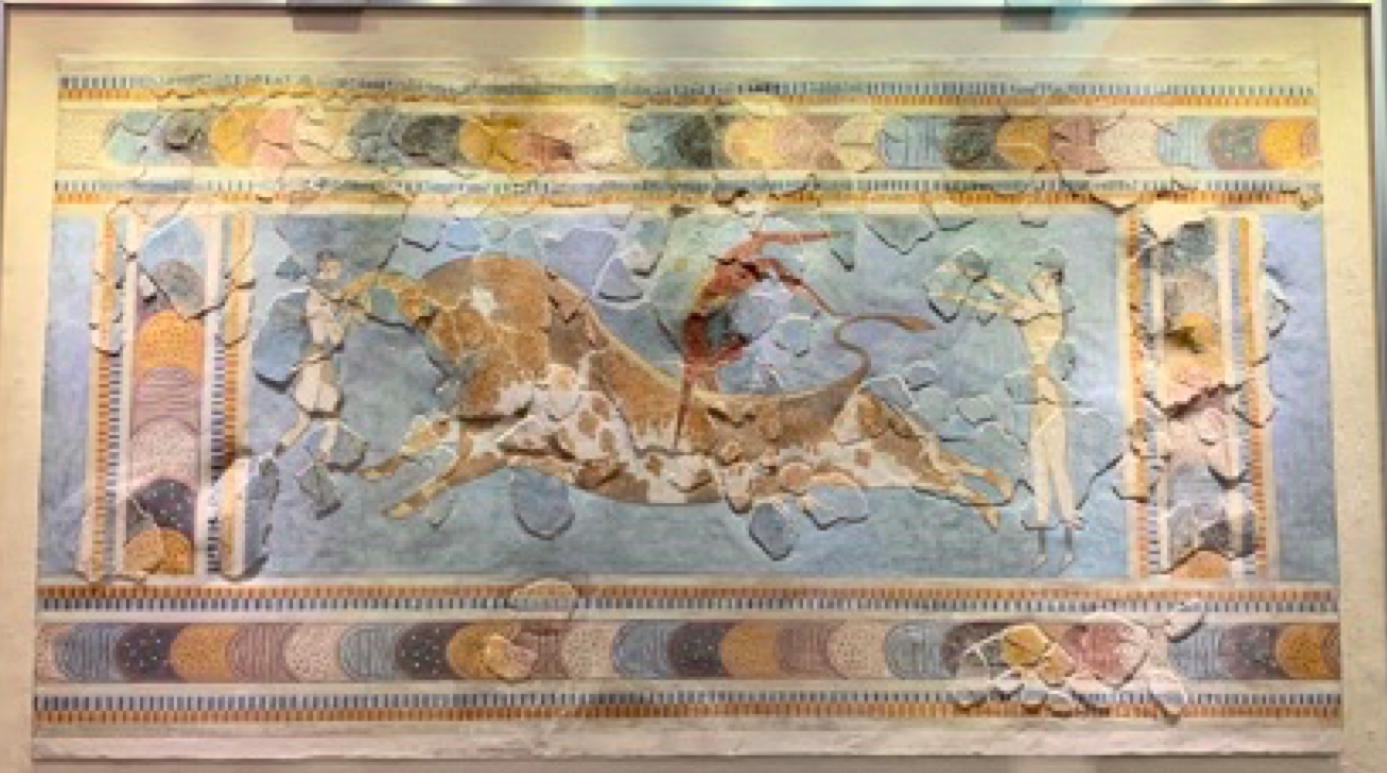
Within the thick walls of the palace, we discovered replicas of ancient frescoes depicting scenes of bull leapers and Minoan sacrifices. My favorite part of the tour was walking through the Throne Room and seeing the actual throne that King Minos sat upon.
Archeological Museum It is important to note that because the Palace of Knossos structure is outdoors, most if not all artifacts found at the site are displayed at the Archeological Museum. It was here that we were able to view the artifacts of everyday life of a Minoan and other Cretans throughout the history of the island. A single, crystal clear, pane of glass stood between me and the most prized golden bee necklace of the ancient world. Other interesting artifacts included: pottery of all sorts and sizes, religious statues, clay sculptures of individual body parts that were thought to be crafted for sacrifices while praying for healing, house models, sarcophaguses, and frescos.
This museum is also where the pieced-together frescoes uncovered at the Knossos Palace are located. My favorite piece illustrates the bull leaping scene which I believe must be one of the first depictions of gymnastics ever, but that idea I intend to further research!
Pottery Class
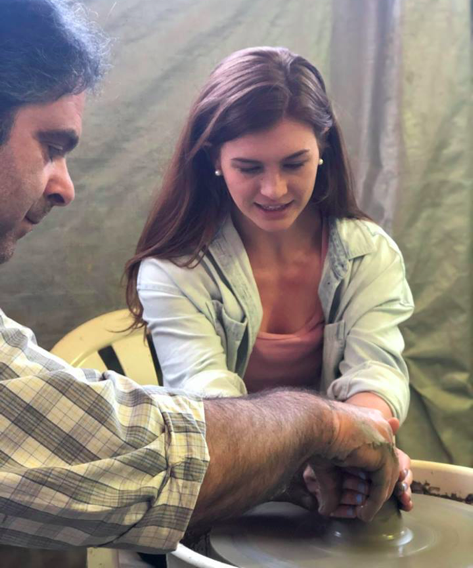
As if viewing the Minoan items today was not eye-opening enough, our next stop was a pottery making class where each of us worked with a master potter to hand craft our own replica of our favorite piece of pottery. This was the highlight of my day! It was so fun to think thousands and thousands of years ago, a young Minoan may have spent their afternoon doing something very similar.
Minoan Lunch Did you think we were finished? We marked off nearly every checkbox today in order to feel the sensation of living in the Minoan Empire. We explored the excavated and reconstructed shell of the Knossos Palace. We then saw up-close the everyday items used by the people who lived there and succeeded in making our own beautiful replicas! All that was left to experience was the smell and taste of the Minoan culture…
To end the day, a meal was made for us that represented the movement of food on Crete from traditional Minoan ingredients that were transcribed in stone found in the Minoan ruins. The dishes included a pork slow cooked in figs and leeks, and lentils with olive oil, sea salt, and honey all of which were cooked over hot embers for hours in traditional clay pots like those that we had just crafted. The meal was earthy, filling, and delish! I also enjoyed trying the twice baked bread which was a staple for storage in the ancient times and the wild greens salad. What a perfect end to our day of time traveling… until tomorrow!
Kalimera, my friend! Thank you for stopping by. Welcome to my travel blog. Follow in my steps, and through me tell the illuminating story of my journey as I come to know the ancient paradise of Crete, Greece!




 Exploring Crete - Bella Santosusso